

Your Forklifts Are Busy But Are They Productive? 3 Steps Beyond Forklift Tracking That Deliver Reliable Material Flow
Learn how real-time forklift tracking, location intelligence and fleet execution reduce empty travel, increase utilisation and improve material flow.
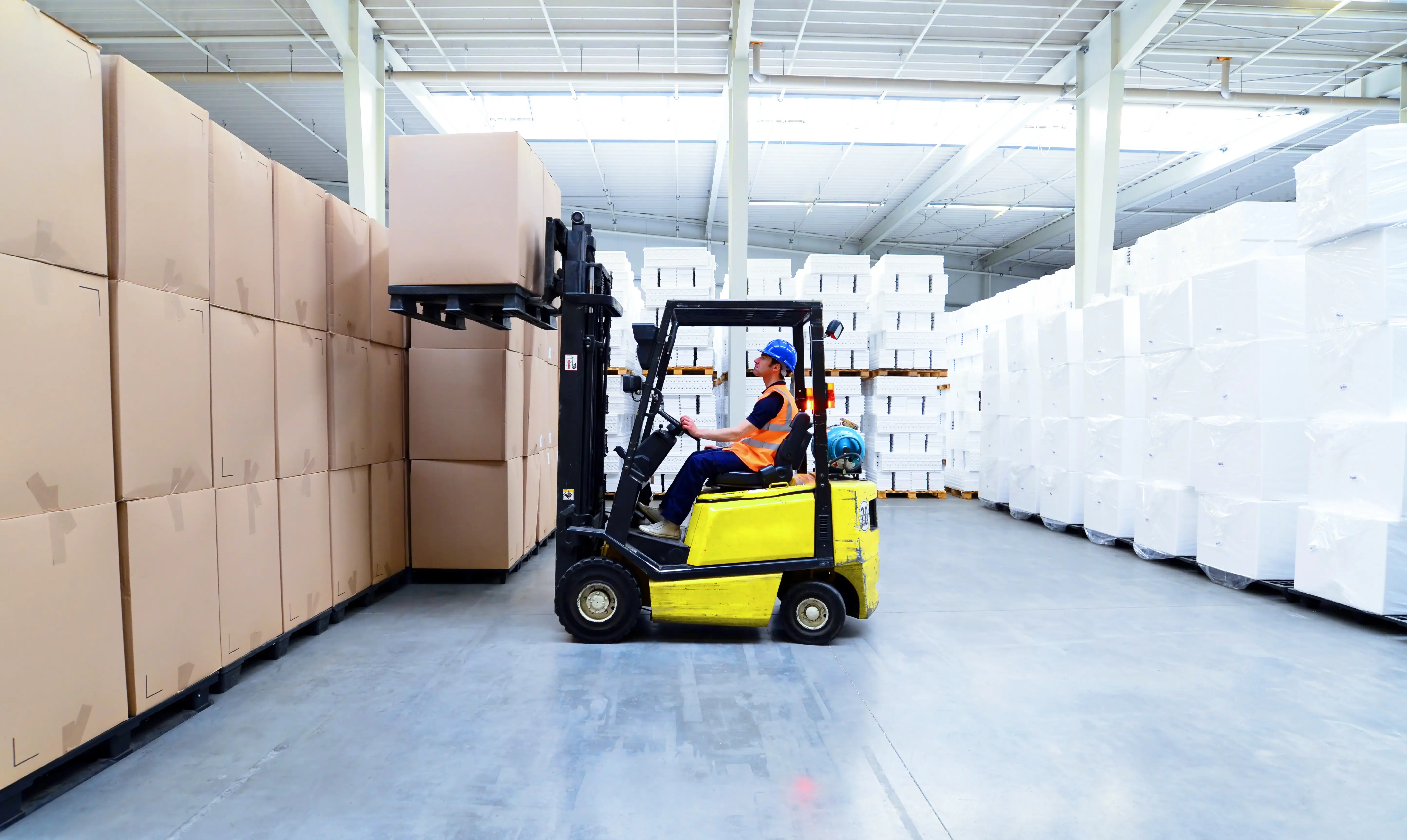
Your pallet sat in staging for 40 minutes, and both systems said everything was fine. Where did the time go? In a recent webinar, Stefan (VP Business Development at KINEXON) and Roland (VP Business Development at Slamcore) argued that ROI and “more forklifts” are the answers, not the questions. Here’s what we’d suggest every intralogistics leader asks before their next fleet purchase order goes out: what are your forklifts actually doing today, where does their capacity disappear, and what is happening between the events in your WMS? Many organizations invest in forklift tracking yet still struggle to understand how vehicle activity impacts throughput, labor efficiency, and overall material flow.

The Questions Every Warehouse Knows Too Well
Walk through any plant or warehouse and you’ll hear the same questions:
- The plant manager: “Why do we need 10 new forklifts? When I walk through the shop floor, I always see our existing fleet standing around doing nothing.”
- The warehouse manager: “The delivery finally arrived and now there’s no forklift to pick up the load at gate 3? Where are they?”
- The safety lead: “How do we keep forklifts, AMRs and people from colliding in a mixed fleet?”
- The IT manager: “How can I trust my WMS data if the data input still relies on manual action.”
Each of these starts as a gut feeling. The thread running through our whole conversation was turning those qualitative statements into measurable facts.
The Numbers Behind the Gut Feeling
When you quantify it, the picture is humbling:
- 30–40% is a typical average fleet utilization. Most operators estimates 80–90%, but once you calculate it properly, it rarely exceeds about 50%.
- Empty runs to distant pick-up spots keep trucks busy, but driving empty.
- Roughly 20% of time can be lost to searching for pallets, loads or drop-off stations.
- Customers see potential for around 30% cycle-time reduction, meaning faster turnaround and higher throughput.
In our first live poll, the audience told us the same story: empty fork travel was seen as the biggest challenge in day-to-day operations.
Traditional forklift telematics systems help, but they only tell part of the story. They can report RPM (Revolutions Per Minute), battery state, impacts, and when a truck was switched on or off. What they typically can't show is where vehicles are spending time and where bottlenecks are forming within the warehouse process, or how much empty travel occurs.
That’s why we believe the core ingredient is live position.
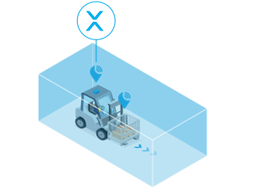
Step 1: Track. Build a Real-Time Forklift Tracking System.
Effective forklift tracking starts with accurate real-time visibility. Rather than relying solely on telemetry data, organizations need a forklift tracking system that shows where vehicles are, where they have been, and how they interact with the material flow.
The foundation is knowing where every vehicle is, all the time, without building infrastructure around it.
Slamcore Aware's vision-based SLAM technology works like “GPS for indoors.” It’s retrofitted to any forklift from any OEM and needs only power and wireless connectivity. Because every movement is continuously captured, operations teams gain forklift location tracking capabilities without installing anchors, markers, or other infrastructure throughout the facility.
In practice that means:
- No reflectors, no fixed infrastructure, no calibration
- Around 20 cm accuracy, plus vehicle direction
- Pedestrian detection near the truck
- Operation at speeds up to 24 km/h, indoors and on short outdoor routes between facilities, even in light levels as low as 10 lux
- Installation and commissioning in under an hour. In about 95% of installations, the data flows the same day: mount in the morning, map the area, see live movements in the afternoon.
Once positions flow into KINEXON, organizations gain a complete view of forklift tracking in warehouse operations, connecting vehicle movements with transport orders, inventory flows, dock processes, and warehouse KPIs.
You can see cornering and acceleration and, when the position data is combined with WMS transport orders, whether a truck is driving loaded or empty. That is information telematics alone does not provide, and it is valuable for utilization as well as maintenance planning.
Where the loss really hides
The inbound-to-loading flow has remained remarkably stable: nine familiar stages. The loss sits in the handovers between them.
Picture a low-lift truck dropping a pallet in the staging area and closing its task in the WMS. A rack truck later collects it. Both did their jobs, and both reported correctly. Yet the pallet sat there for 40 minutes, and nobody knew where or why.
You can’t fix what you can’t see. The WMS shows what should happen. Movement data shows what actually happened in between.
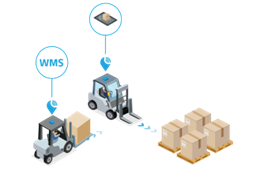
Step 2: Guide. The Right Task for the Right Operator.
Tracking answers “Where’s my truck?” The goal isn’t a busy forklift, though. It’s a reliable material flow and its orchestration, because that’s where the money comes from.
In many operations today, work runs on printed papers, supervisors, walkie-talkies, and the memory of experienced drivers who know that on Monday at 9:00 a supplier truck arrives. That works until that driver goes on vacation or leaves, and the experience goes with them.
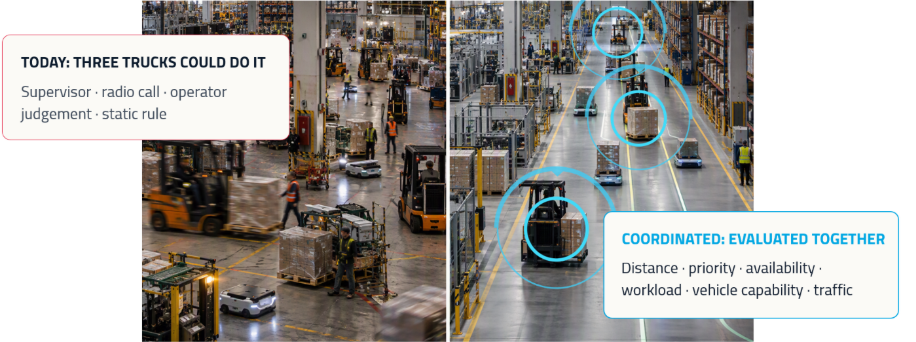
This is where many forklift monitoring systems stop. They provide visibility but leave dispatching decisions to supervisors, radio calls, spreadsheets, or tribal knowledge. The next step is transforming visibility into action.
KINEXON forklift guidance puts the operator and truck into the system as a resource. The driver sees only the orders they’re supposed to execute, assigned based on real-time position, status, distance, priority, workload and vehicle capability (a one-ton truck is not a two-ton truck).
The effects:
- Fewer empty runs. The next closest order is assigned as soon as the operator confirms a drop-off.
- No more standoffs where two drivers pick the same job at the same time.
- Automatic status updates back to the WMS or ERP (including SAP EWM). Operators no longer scan locations or orders manually, which removes non-value-adding steps.
- Fewer manual errors, with alerts if a pallet is placed in the wrong spot.
The result is higher labor productivity, better fleet utilization, and full transparency for every movement.
In our second poll, we asked what the biggest benefit of centralized fleet management would be. Reduced empty trips were the headline for us, and automated real-time decision-making was the natural next step.
Step 3: Orchestrate. Forklifts With Robots, Not Against Them.
Automation loves repeatability. Many customers start automating with the most common A-to-B transport, which is exhausting for a human doing it for eight hours straight. But automate one flow and the rest of the operation stays manual or mixed, and that’s where orchestration comes in.
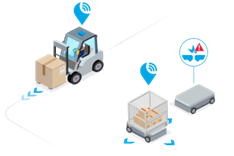
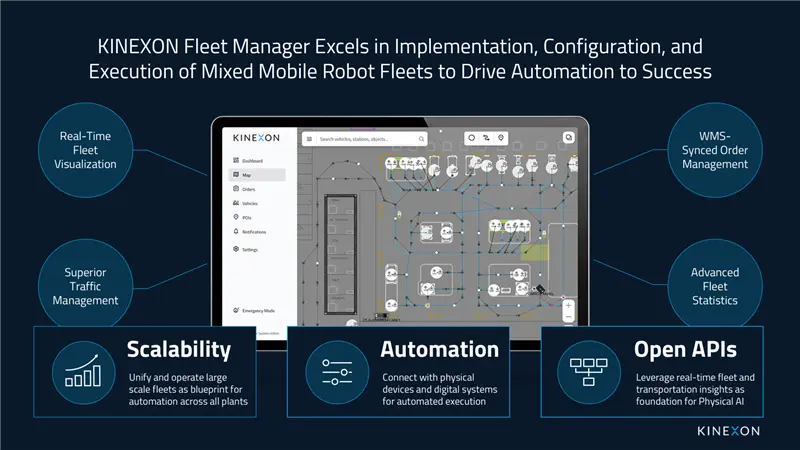
Orchestration puts manual forklifts, AGVs, AMRs and even tugger trains on one map and one layer, connected via VDA 5050 as a scalable standard. Vehicles see each other before a conflict happens. If a forklift parks in a section, that area can be disabled so an AMR is rerouted instead of getting stuck. Add traffic management, route optimization, and avoidance of busy intersections, and each transport task is done by the right resource at the right time.
It’s not forklifts versus robots. Over the next decade, mixed and hybrid fleets will be the norm, and the winners will be the operations that run them safely and efficiently as one system.
The product behind hybrid fleet orchestration?
KINEXON Fleet Manager is a vendor-agnostic, central orchestration platform allowing you to automate order transportation across forklifts and mobile robots connected to all major WMS and enterprise systems, including a certified integration with SAP EWM.

The Takeaway
Tracking to see. Guiding to act. Orchestrating to scale. Three modular steps, like building blocks, turn invisible movement into reliable execution.
Before you ask, “How many more forklifts do we need?” or “What will the ROI be?”, ask a more useful question: what is happening between the events in your WMS? That’s where your hidden capacity lives.
Once the system is running, the questions change from finding lost capacity to deciding where to use it next:
- The plant manager: “We freed up two trucks. Where else can we use them?”
- The warehouse manager: “Could we increase throughput or extend the warehouse without adding vehicles?”
- The safety lead: “Near-misses are down. Which zone do we tackle next?”
- The IT manager: “The WMS updates itself now. Which manual scans can we remove next?”
Together, the three steps form a forklift execution system: Slamcore Aware provides the position layer, while KINEXON Forklift Guidance and KINEXON Forklift Fleet Execution turn that data into execution and orchestration.
Watch the Full Webinar on Demand
Want to see the live demos, the simulated guidance in action, and the full Q&A? Watch the on-demand webinar: “Forget ROI, Forget More Forklifts: Three Steps That Really Matter” and hear Stefan and Roland walk through it themselves.
See Your Use Case in a Demo!
Ready to see it in your own operations? Book a demo with KINEXON and Slamcore, and we’ll show you what your forklifts are really doing and where hidden capacity can be recovered.
More Resources
Stay Up to Date
Subscribe to our newsletter and stay connected. You can unsubscribe at any time.
Ready to automate your industrial operations?
Schedule a meeting with our experts to connect and automate your operations.
Get in touch